The CSMS that runs the charger, the money and the paperwork.
PixellEnergy CSMS is the charging station management system behind our own network — OCPP 2.0.1 native, GST-invoiced end to end, and settling every session directly into your bank account on T+1.
 Network operations
Four things a board actually asks.
Most Indian charging software is an OCPP 1.6 dashboard with a payment link bolted on. These are the four differences that decide whether a network survives its third audit and its first hundred chargers.
OCPP 2.0.1 native — not 1.6 with a wrapper
Device management, security profiles, smart charging and diagnostics are implemented at the protocol level, so a fault is visible in seconds instead of on the next driver complaint.
Isolated tenancy, ISO 27001-aligned handling
Your sessions, drivers and tariffs live in your own tenant. TLS 1.3 in transit, DPDP-ready consent records, and an immutable audit log that survives investor due diligence.
Money moves to you, not through us
Sessions settle straight into your bank account. No PixellEnergy escrow, no float held against your revenue, no commission when you run under the PixellEnergy brand.
Vendor-neutral by design
Any OCPP-compliant charger, any payment gateway, any map provider. Swap a component without rewriting the platform — the exit cost is what makes the entry safe.
Enterprise features, explained in plain language.
You don't need to speak OCPP to run a profitable station. Six things the CSMS does for you, your staff and the driver standing at the charger.
Number-plate whitelisting
The bay camera reads the plate and unlocks the charger only for approved cars.
Autocharge — plug in and go
The charger recognises the car, starts the session and bills the linked wallet.
RFID cards in 30 seconds
Issue, top-up, suspend or cancel a card from the console — drivers, chauffeurs, fleets.
Download your UPI QR code
Print a UPI QR per bay. Drivers pay directly and the session reconciles itself.
Tariffs, idle fees, happy hours
Price by hour, site or user group. Charge for overstay, discount empty nights.
GST invoices without an accountant
Every session invoices itself. Registers export to Excel or your ERP.
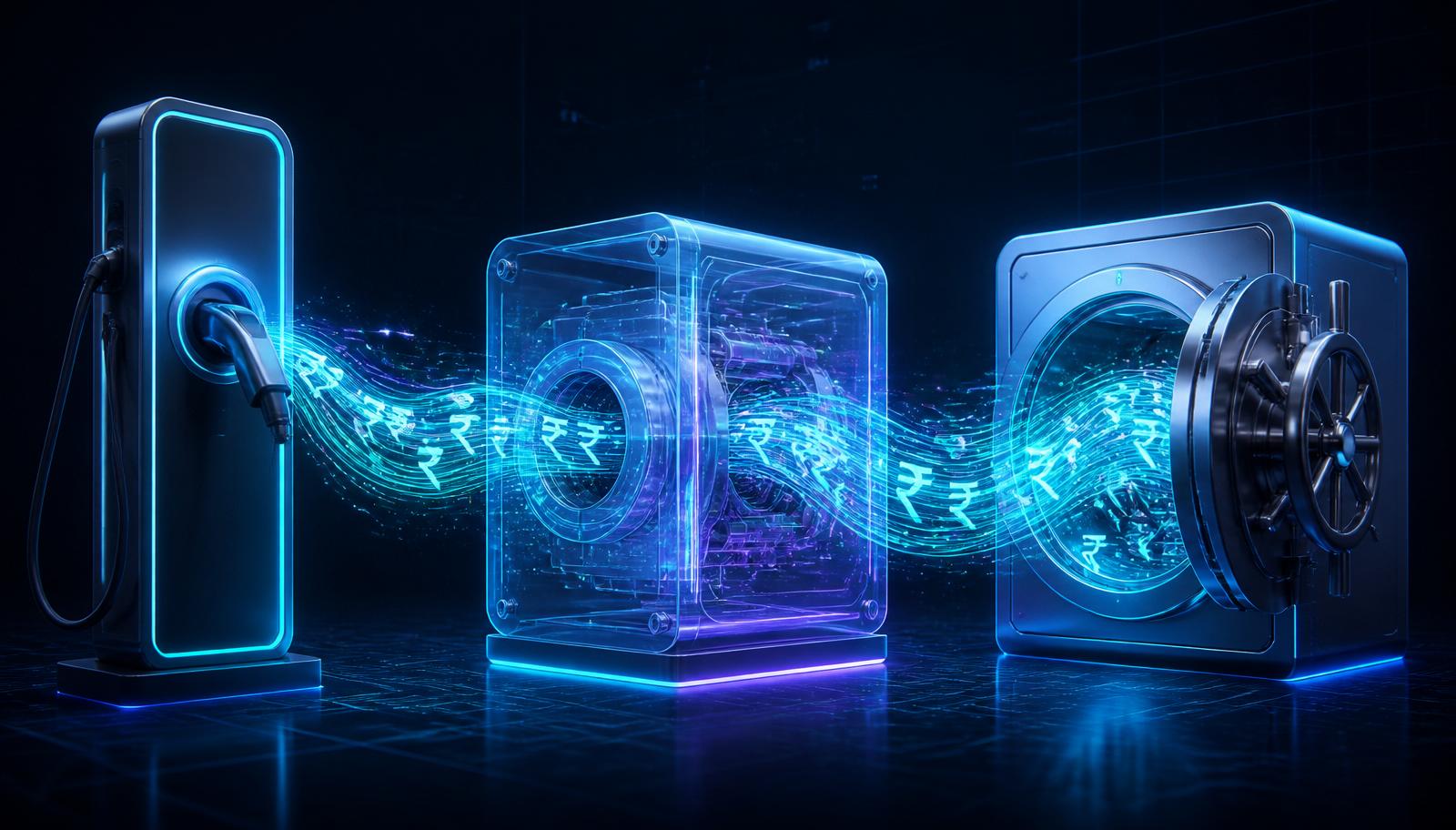
From meter tick to your bank account — no detours.
Run under the PixellEnergy brand and we take nothing per session. No revenue share, no per-kWh platform tax, no escrow sitting between your charger and your account. The CSMS computes GST and MDR, splits any franchise share, and pays out on T+1.
- 0% commission on the PixellEnergy brand — forever
- Sessions settle direct to the CPO account, never to escrow
- MDR-transparent reconciliation against the gateway file
- GST-ready invoice registers and franchise statements

Your chargers, discoverable beyond your own app.
Circle is our OCPI 2.2.1 roaming hub. Partner drivers charge on your stations without a second wallet, your drivers roam onto partner networks, and every cross-network CDR reconciles itself.
We speak every OCPP dialect — natively.
One stack across OCPP 1.6J, 2.0.1 and 2.1 — so legacy hardware, new hardware and tomorrow's bidirectional fleet all run on the same console.
| Capability | OCPP 1.6J | OCPP 2.0.1 | OCPP 2.1 |
|---|---|---|---|
| Transport | JSON / WSS | JSON / WSS | JSON / WSS + MQTT |
| Core session control | |||
| Smart charging profiles | Basic | Advanced | Advanced + local |
| Device management (firmware, logs, monitoring) | — | ||
| ISO 15118 Plug & Charge | — | ||
| Bidirectional / V2G (ISO 15118-20) | — | — | |
| Battery swap & reservation v2 | — | — | |
| TLS 1.3 + mutual auth | Optional | ||
| OCPI 2.2.1 roaming bridge |
OCPP 2.1 (published by the Open Charge Alliance) adds native bidirectional / V2G flows, battery-swap primitives and local smart-charging — supported in the PixellEnergy CSMS today.